
The Copper Is Going Away. Your Elevator Phone Isn't.
Posted by Quentin Vernon on 3rd Aug 2026
Are POTS lines actually going away?
Yes. Copper POTS lines are being retired on a carrier-by-carrier schedule, and the process is already underway. There is no single FCC-mandated nationwide shutdown date, but the practical deadlines are now specific enough to plan against. AT&T stopped accepting new orders, moves, and changes on copper lines across roughly 20 states on October 15, 2025, began permanently decommissioning wire centers in mid-2026, and has stated it expects to be out of the copper business across the vast majority of its footprint by the end of 2029.
The FCC has removed most of the friction that used to slow this down. Orders adopted in March 2025 and March 2026 eliminated network-change disclosure filing requirements, streamlined Section 214 discontinuance, and dropped the requirement that carriers offer a standalone voice alternative before retiring copper. In practice, that means a carrier can move your service onto a sunset track with customer notification and no FCC review, and copper-retirement notices may only appear on a carrier website or in an industry publication rather than in your mailbox.
The important part for facilities and IT teams: the transition does not necessarily require replacing every device attached to a copper line. It requires a controlled infrastructure plan.
Key takeaways
- Copper retirement is a real, dated process. AT&T's order freeze began October 15, 2025, physical wire-center decommissioning started in mid-2026, and the company has targeted the end of 2029 for the bulk of its footprint.
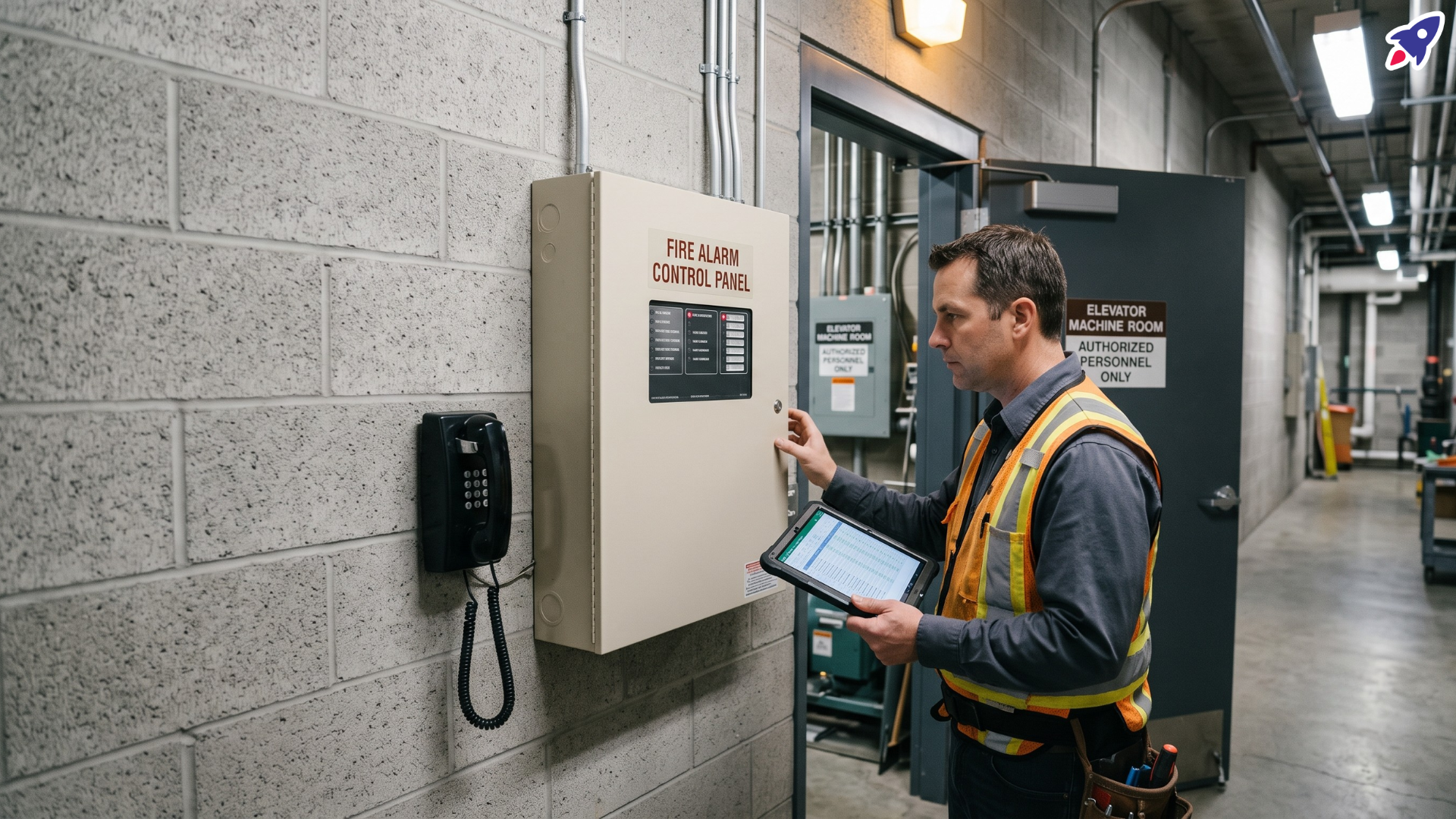
- Most surviving analog lines are not desk phones. They serve fire alarm panels, elevator emergency phones, entry systems, call boxes, fax machines, and monitored equipment owned by facilities, security, or outside contractors.
- For fire alarm signaling, the replacement network matters as much as the device. NFPA 72 recognizes a Managed Facilities-based Voice Network (MFVN) as functionally equivalent to traditional carrier service; a generic VoIP line is not the same thing.
- Dial tone is not a passing test. Confirm that the alarm signal reaches the monitoring center, the elevator call reaches a staffed response point, and location data transmits correctly.
- Copper carried its own power. Digital and cellular replacements depend on premises equipment, so backup power and redundancy have to be designed in, documented, and maintained.
- Do not wait for a notice. Under the current rules, the notice may never reach the person who owns the equipment.
Why is the copper shutdown an infrastructure project, not a phone-bill change?
Framing POTS retirement as a telephone-service change is the most common planning error. Employee calling has usually already moved to mobile devices, cloud phone platforms, or unified communications. What remains on copper is equipment nobody in IT installed and nobody in finance can identify from a bill.
A surviving analog line commonly terminates at:
- An elevator machine room
- A fire alarm control panel
- A security office or intrusion panel
- A loading dock or gate intercom
- A building entrance or callbox
- A mechanical room or pump house
- A public emergency or blue-light phone
- An older fax or modem connection
That distribution makes this a cross-functional project by definition. IT understands connectivity. Facilities knows where the devices are. The alarm company understands signaling paths and supervision. The elevator contractor knows what the code requires for emergency communication. Finance is often paying for lines nobody can map to a purpose. Those groups need to be in the same conversation before anything is disconnected.
How do you find every remaining POTS line?
Start with an inventory, not a vendor. Do not assume existing records are complete. Many analog lines were installed years ago by employees, contractors, or vendors who are no longer involved, and the billing description rarely says what the number actually does.
For each line, document:
- Telephone number and service address
- Physical termination point
- Connected device, manufacturer, and model
- Responsible department and internal owner
- Monitoring or service provider
- Business purpose
- Monthly cost, including recent rate increases
- Any safety, contractual, or regulatory requirement attached to it
Low call volume proves nothing. A fire panel may only seize the line during a scheduled test, a trouble condition, or an actual alarm. An elevator phone may sit idle for years and then be the only communication path a trapped passenger has. A line should never be disconnected until the organization understands what it supports.
One practical note: pull the last twelve months of invoices while you do this. Copper rates have risen sharply as carriers grandfather legacy services, and the cost column is often what gets a migration budget approved.
What should you preserve, replace, retire, or investigate?
Once the inventory is complete, sort every device into one of four categories. The point is to make a deliberate decision about each one rather than a blanket decision about all of them.
Preserve and migrate
The equipment is reliable, still supported, and suitable for operation over a compliant replacement connection.
Replace
The device is obsolete, unsupported, unreliable, or unable to meet current operational or code requirements.
Retire
The line and equipment no longer serve a necessary business function.
Investigate
The organization cannot yet confirm what the line supports, who owns it, or whether it is still required. Nothing in this category gets disconnected.
This sorting avoids two opposite failures. The first is replacing functioning equipment simply because its copper connection is being retired. The second is preserving old equipment by default when the transition is a rare, funded opportunity to correct reliability, support, or compliance problems that have been deferred for a decade.
Can you keep analog equipment after copper retires?
Often, yes. A communications network can become obsolete while the equipment using it remains perfectly functional. Managed POTS-replacement services present an analog-style loop-start interface to your existing device while carrying the traffic over a modern network, typically cellular, wired broadband, or both.
Ooma AirDial is one of the established options in this category. Ooma states that AirDial supports fire and burglar alarm panels, elevator and blue-light emergency phones, building entry systems, facility phones, fax machines, and backup phone lines. Its patented MultiPath feature is an active-active design: voice traffic is transmitted over the device's LTE connection and the customer's wired Ethernet simultaneously, with the system continuously monitoring both links, rather than holding a secondary link in reserve and switching after a failure. Ooma also positions AirDial as MFVN-compliant, meaning traffic does not traverse the public internet, and certifies the device to operate across multiple US carrier networks.
One caution worth applying to any vendor, including this one: published battery-runtime figures vary between datasheet revisions and configurations. Ooma documentation has cited 16 hours of standby time in one datasheet, more than 48 hours in a later one, and more than 24 hours with a modular external battery. Runtime depends on load, signal conditions, and the accessories specified. Verify the number against the current spec sheet for the exact configuration you are buying, and against what your AHJ requires, rather than against a marketing page.
None of these capabilities make any POTS-replacement product automatically suitable for a given installation. Compatibility has to be verified against the specific device, the monitoring arrangement, and the operational requirement.
Why do NFPA 72 and MFVN matter for alarm lines?
This is the detail most POTS migration plans miss, and it is the one most likely to fail an inspection.
NFPA 72, the National Fire Alarm and Signaling Code, defines a Managed Facilities-based Voice Network as a managed network of physical facilities, operated and maintained by the service provider, that transmits real-time signals without altering their format between the protected premises and the point of interconnection. The code's explanatory material describes MFVN service as functionally equivalent to traditional carrier service with respect to dialing, call completion, carriage of signals and protocols, and loop voltage treatment, and expects a loop-start interface, pathway reliability assured by proactive provider management, and standby power capacity for the communications equipment at the protected premises. Local AHJs have used that language since the 2010 edition to decide whether a given line is acceptable for transmitting alarm signals to a supervising station.
The practical consequence: not every digital voice line qualifies. A consumer-grade VoIP adapter riding the open internet is a different animal from an MFVN service, even though both deliver dial tone. Where a digital alarm communicator transmitter is involved, NFPA 72 also allows other approved transmission means, so a second valid path is to move the panel off a phone line entirely and onto a listed cellular or IP alarm communicator supplied by the alarm vendor.
Elevator emergency communication runs on a parallel track. ASME A17.1 section 2.27.1 is written in performance language: it requires a two-way communications means between the car and a location staffed by authorized personnel able to take appropriate action, and newer editions and local amendments add further requirements. Because the code describes the outcome rather than the method, your elevator contractor and AHJ, not the connectivity vendor, are the ones who confirm the replacement satisfies it.
How should you test a POTS replacement?
A replacement connection can produce a clean dial tone and still fail the system attached to it.
Dial tone does not prove an alarm signal reached the monitoring center. It does not confirm an elevator call reached the correct staffed response point. It does not show that location and identification data transmitted accurately. Test the function, not the facility.
- Elevator phones: confirm the call reaches the designated response point, that the responder receives the car and building identification required for the installation, and that any automated messaging or supervision behaves as specified.
- Alarm panels: confirm signals arrive at the supervising station accurately and within the required time window, and that trouble and supervisory conditions report correctly, not just alarms.
- Entry and security systems: exercise every normal and emergency communication function, including after-hours paths.
- Fax and modem lines: test with real documents and real destinations, since analog modem traffic is more sensitive to packet handling than voice.
The alarm company, elevator contractor, monitoring provider, facilities team, and equipment specialist should participate in acceptance testing and sign off on the results. Keep the original line active until the replacement has passed documented functional testing, and keep that documentation for your next inspection.
What happens to these systems during a power outage?
Traditional copper service could usually keep working through a local outage because the line was powered from the central office. Digital and cellular replacements depend on equipment at the customer's premises.
That equipment may include a gateway, broadband modem, router, network switch, fiber terminal, cellular radio, and the local power supplies feeding all of them. If any required component loses power, the connected system stops communicating, and in a life-safety context that is a reportable failure rather than an inconvenience.
Design the backup power explicitly. Determine:
- How long each system must remain operational, and what the applicable code requires
- Which components in the chain need backup power, not just the endpoint device
- Whether batteries, a generator, or both will be used
- Who monitors backup status and receives low-battery alerts
- How often batteries are inspected, tested, and replaced
- What happens when backup capacity is degraded or unavailable
A battery specification on a product sheet is not a resilience plan. Batteries age. Equipment gets moved. Power supplies get unplugged during unrelated work. Network hardware is swapped out by someone who has no idea it supports an emergency system. Resilience requires continuing ownership and maintenance, and it should be written into the same inspection cycle as the device it protects.
How do you avoid creating a new single point of failure?
Swapping a copper line for one broadband connection does not automatically improve reliability. The circuit can fail. A router can reboot into a bad state. Local cabling gets damaged during construction. A regional outage can take down several systems at once.
Critical installations usually need more than one communications path. Approaches differ: some products, including Ooma AirDial's MultiPath, run traffic across two links simultaneously; others use conventional failover from a primary to a secondary connection. Either way, ask the same questions of any vendor:
- What happens the moment the primary path fails, and how long does the transition take?
- Is the secondary path genuinely independent, or does it share local power, cabling, or hardware with the primary?
- Who is alerted when connectivity is lost, and through what channel?
- How is the failure detected if the device is otherwise idle?
- How often is redundancy actually tested, and by whom?
Redundancy that has never been exercised is a design assumption, not proven resilience.
How should multi-site organizations migrate?
Do not convert every location at once. A phased migration lets you test the process, surface unexpected problems, and refine the deployment standard before it is replicated across a portfolio.
Build the pilot from a representative mix rather than the easiest sites:
- One elevator phone
- One fire or burglar alarm panel
- One entry or access system
- One ordinary facility phone or fax line
- A site with strong cellular coverage
- A site with known coverage or network problems, ideally a basement or machine room
Document installation requirements, device compatibility, test procedures, backup-power performance, connectivity failures, contractor responsibilities, support escalation paths, and lessons learned. Those findings become the repeatable standard for the remaining locations, and they are what turns a hundred-site rollout into a process instead of a hundred separate projects.
Who owns the system after the migration?
The project is not finished when the copper line is disconnected. Someone has to remain accountable for:
- Connectivity monitoring and alert response
- Battery inspection and replacement
- Periodic device and signal-path testing
- Carrier and vendor escalation
- Documentation and as-built records
- Equipment and firmware updates
- Regulatory inspections and AHJ coordination
- Change control when the building or network is modified
Without named ownership, a well-designed replacement quietly becomes the next forgotten piece of infrastructure. The same lack of visibility that created undocumented copper dependencies reappears in digital form, and it will be discovered the same way: during an inspection or an emergency.
Should you wait for a carrier notice?
No. Building a migration plan around the assumption that a clear disconnection notice will reach the right person at the right time is the weakest part of most POTS strategies.
FCC rules still govern discontinuance, and a notice floor remains in place for copper retirement, but the March 2025 and March 2026 orders removed the requirement to file network-change disclosures with the Commission. Carriers can satisfy notice obligations by posting on their websites or through industry publications. Even when a notice does arrive, comment windows are short and the recipient of record is often an accounts-payable address rather than the facilities manager who owns the elevator phone.
Your carrier also does not know what is on the other end of the line. It may not know that a number serves a fire panel, an elevator, or an emergency callbox. It is not responsible for testing your device or for confirming that a replacement satisfies your code obligations.
Contact your carrier directly and ask for the status of each remaining legacy service, including grandfathering status and any wire center scheduled for retirement. Waiting until a line is already on a disconnect list leaves too little time for inventory work, budgeting, contractor coordination, testing, and correction.
POTS transition checklist
- Inventory every remaining analog line and the device attached to it.
- Flag safety-critical and regulated systems: fire, elevator, area of refuge, emergency callbox.
- Sort each device into preserve, replace, retire, or investigate.
- Confirm the compliance path for each critical line, including MFVN status or an approved alternate transmission means.
- Evaluate replacement services against the actual device, not the general category.
- Test real function with the alarm company, elevator contractor, and monitoring provider present.
- Design and document backup power for every component in the chain.
- Verify that redundant paths are independent, and test them.
- Migrate in phases, starting with a representative pilot.
- Assign named long-term ownership before the project closes.
FAQ: POTS line replacement
When exactly do POTS lines stop working?
There is no single national date. Timing depends on your carrier and your specific wire center. AT&T stopped new copper orders across roughly 20 states on October 15, 2025, began decommissioning wire centers in mid-2026, and has indicated it expects to exit copper across most of its footprint by the end of 2029. Other carriers are running their own schedules. Ask your carrier for the status of each line rather than relying on a general timeline.
Can I just move my fire alarm panel to a normal VoIP line?
Usually not. NFPA 72 treats a Managed Facilities-based Voice Network as functionally equivalent to traditional carrier service for alarm transmission, and a consumer-grade VoIP line on the public internet does not meet that description. Either use an MFVN-compliant replacement service or move the panel to a listed cellular or IP alarm communicator. Confirm the approach with your alarm provider and AHJ before disconnecting anything.
Do I have to replace my elevator phone and alarm panel?
Not necessarily. Many analog devices continue to work normally over a compliant POTS-replacement connection. Replacement is warranted when the equipment is obsolete, unsupported, unreliable, or unable to meet current code, not simply because copper is going away.
What happens to these systems in a power outage?
Unlike copper, digital and cellular replacements draw power at your premises. Every component in the path, including the modem, router, and gateway, needs backup power sized to your operational and code requirements, plus monitoring and a battery replacement schedule.
How long does a POTS migration take?
For a single small site, weeks. For a multi-site portfolio with life-safety equipment, plan on months, because inventory, contractor scheduling, functional testing, and AHJ coordination drive the timeline more than the hardware installation does.
What if I do nothing?
Two outcomes are common: escalating rates on grandfathered lines, then a forced cutover on the carrier's schedule instead of yours. The second is the expensive one, because emergency migrations skip pilot testing and rarely leave time to correct compliance gaps before an inspection.
Bottom line: preparation is the survival strategy
Businesses do not need to panic about the end of POTS. They do need to stop treating legacy copper lines as invisible utilities that will keep working indefinitely.
The disappearance of copper does not have to trigger a chaotic building-wide replacement project. Some equipment should be replaced. Some should be retired. A great deal of it will provide years more useful service on a properly specified modern connection. The smartest transition is not the one that replaces everything old. It is the one that identifies which part of the system is actually obsolete and changes that part without introducing new operational risk.
Global Teck Worldwide helps organizations sort out the communications hardware side of that transition, from facility phones and conference endpoints to the headsets and devices your team uses every day.
Mapping your remaining analog lines and not sure what to keep?
Contact Global Teck Worldwide